Medium-Density Fiberboard, commonly known as MDF, has undergone a massive glow-up. Gone are the days when it was seen as just a “cheap” alternative to solid wood. Today, it is a darling of the interior design world, prized for its versatility, smooth finish, and cost-effectiveness.
Whether you are a landlord/homeowner planning a renovation or a designer looking for the perfect material for custom cabinetry, understanding how to leverage MDF can elevate your project without breaking the bank.
What exactly is MDF?
Before diving into its uses, it’s helpful to understand what you’re working with. MDF is an engineered wood product made by breaking down hardwood or softwood residuals into wood fibres. These fibres are combined with wax and a resin binder and formed into panels by applying high temperature and pressure.
The result is a material that is denser than plywood and lacks the knots or grain patterns found in natural timber. This consistency is exactly why interior designers love it.
Seamless custom cabinetry and millwork
One of the most popular applications for MDF in homes is custom cabinetry. Because MDF is incredibly stable, it doesn’t expand and contract with humidity changes as much as solid wood does. This makes it the ideal candidate for painted kitchen cabinets and bathroom vanities.
Why designers choose MDF for cabinets:
- Ultra-Smooth Surface: Since there is no wood grain to telegraph through, you get a “factory-finish” look that is impossible to achieve with oak or pine.
- No Cracking: Solid wood door frames often develop hairline cracks at the joints due to movement; MDF stays perfectly still.
- Intricate Routing: You can use a CNC machine to carve elaborate “shaker” styles or beaded details directly into a single slab of MDF, creating a seamless look.
Architectural details: trim, moulding, and wainscoting
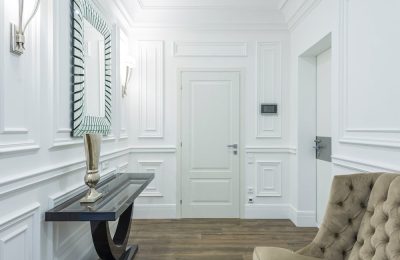
If you walk into a modern luxury home, there’s a high probability that the crown moulding, baseboards, and decorative wall panelling are made of MDF.
Interior designers use MDF for wainscoting and shiplap because it provides a crisp, clean line. When you’re aiming for that “Picture Frame” moulding look on a feature wall, MDF’s uniformity ensures every piece matches perfectly. It’s also significantly easier to sand and paint than traditional lumber, saving hours of labour on the job site.
Functional and stylish furniture
From high-end retail displays to the bookshelves in your home office, MDF is everywhere. It is the backbone of the “built-in” look. Designers often create wall-to-wall libraries using MDF because it can support significant weight when engineered correctly (though it’s important to account for “span rating” to avoid sagging).
Because it is so easy to cut into unique shapes, it’s also used for:
- Curved furniture: Thinner sheets of MDF can be layered or “kerfed” to create rounded corners and organic shapes.
- Headboards: Custom-shaped, upholstered headboards often use an MDF core for structural integrity.
- Media centres: The material’s density helps with sound dampening, making it a favourite for speaker enclosures and home theatre units.
Creative wall art and room dividers
Modern interior design often plays with texture and light. Laser-cut MDF panels are frequently used as decorative room dividers or 3D wall art. Because the material is isotropic (it has the same properties in all directions), it can be cut into incredibly intricate, lace-like patterns without the risk of splitting.
These panels can be painted in bold metallics or muted mattes to create a focal point in a lobby or a residential living room.
Working with MDF: pro tips for success
While MDF is a powerhouse material, it does require specific handling to look its best.
- Seal the edges: The edges of MDF are more porous than the faces. Designers ensure their contractors use an edge-sealer or extra primer on the “end grain” to prevent the paint from soaking in unevenly.
- Use the right grade: For bathrooms or kitchens, always specify moisture-resistant (MR) MDF. It is treated with a special resin to prevent swelling in damp environments.
- Mind the Weight: MDF is heavy! It’s important to ensure that wall-mounted units are anchored properly into studs.
If you are a DIY enthusiast or a contractor looking to start a new project, you can easily order MDF through local timber merchants or specialised suppliers to get the exact thickness and grade required for your specific design needs.
The sustainable edge
Many modern MDF products are becoming more eco-friendly. Many manufacturers now use recycled wood content and offer “no-added formaldehyde” (NAF) options. For LEED-certified projects or health-conscious homeowners, these sustainable MDF choices provide the aesthetic benefits of engineered wood without compromising indoor air quality.
Final thoughts
MDF has earned its place as a staple in interior design. Its ability to take paint beautifully, its structural stability, and its incredible versatility make it a “secret weapon” for creating high-end looks on a realistic budget. From the floorboards to the ceiling trim, MDF provides the smooth, clean canvas that modern aesthetics demand.